
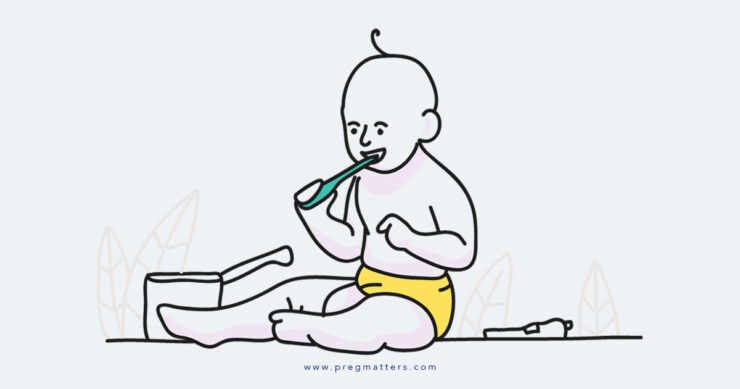
Start brushing as soon as your baby’s first tooth appears. Do not wait for a full set of teeth, a particular birthday or the tooth to finish coming through. Use a small, soft toothbrush twice a day.
Before there are teeth, you can gently wipe the gums with a clean damp cloth. This can help your baby become familiar with mouth care, but it is different from brushing teeth once they arrive.
Before the first tooth

Wash your hands and use a clean, soft damp cloth to gently wipe your baby’s gums. Keep them comfortably supported and be gentle; you do not need toothpaste for toothless gums.
You are building a familiar routine, not trying to make the mouth sterile. Mouth care should not become a reason to delay a hungry baby’s milk feed or scrub tender tissue.
When that first tooth appears
The timing varies. Many babies get their first tooth around six to ten months, while others are earlier or later. Most children have all 20 baby teeth by about three years. Start the brushing routine when you see the first tooth, even if your baby is younger than the usual age.
The Royal Children’s Hospital dental-care guide recommends adult brushing with a small soft brush twice a day. If no teeth have appeared by your baby’s first birthday, mention it at their dental check rather than waiting indefinitely.
For the hands-on sequence, see how to brush your baby’s teeth properly. Sore gums do not mean tooth cleaning should stop, but use gentle pressure and get advice if pain prevents it.
When do you introduce toothpaste?
In Australia, the usual starting point is water-only brushing before 18 months. From 18 months to under six years, a small pea-sized amount of low-fluoride children’s toothpaste is generally recommended. An adult needs to apply it and supervise, encouraging spitting rather than swallowing and avoiding rinsing afterwards.
Your dentist may advise starting fluoride earlier or using a different strength if your child’s decay risk is higher. Fluoridated-water exposure, previous decay and health or feeding factors can influence that plan. Ask which paste and amount suit your child rather than copying an overseas age chart.
Victorian Health fluoride advice explains the general age stages, while the Australian Dental Association’s infant guidance describes individual exceptions. If your dentist has already given you a specific plan, follow it and ask them about any uncertainty.
When should the first dental visit happen?
The Australian Dental Association recommends a first visit when the first tooth appears or by age one, whichever comes first. You do not need to wait for a problem. A visit is still useful if there are no teeth yet.
The dentist can check the mouth and tooth development, assess decay risk, show you brushing and discuss feeding, dummies, teething and toothpaste. Bring your questions and any relevant medical information. Ask when the next visit should be; recall timing can be tailored to your child.
See the ADA first dental visit factsheet. A general dental practice that sees young children can be a starting point; the team can advise if specialist paediatric care is needed.
What can you do between visits?
- Keep brushing twice daily. Regular adult help is more valuable than expecting a toddler to manage alone.
- Look at the teeth. Gently lift the lip to check for new white, brown or black marks that do not clean away. Arrange a dental assessment if you see them, even without pain.
- Keep bottles out of the sleep space. Hold your baby for a bottle feed and remove the bottle when they finish. Do not prop a bottle or leave it in bed for comfort sucking.
- Avoid sugary extras. Do not sweeten dummies or put juice, cordial or other sweet drinks in a baby’s bottle.
Young babies still need their usual breastmilk or formula feeds, including overnight when needed. Do not cut milk feeds simply because a tooth has appeared. If you have concerns about frequent feeding, sleep and dental health, ask your child’s health and dental teams for a plan suited to their age.
NSW Health’s early-years oral-health advice covers simple preventive habits. It does not replace a dental examination.
Reasons to book sooner
Get advice promptly if your baby has persistent mouth pain, feeding difficulty, gum bleeding, an injured tooth or a tooth present at birth. Facial swelling or pus needs urgent dental or medical assessment. Call 000 for breathing or swallowing difficulty.
Do not put fever, diarrhoea or a generally unwell baby down to a new tooth. Our teething guide explains comfort measures and signs that need medical care.
If you have missed the first-year check, book now. You can start improving the routine today without trying to make up for every missed brushing session.